AI Fear, Data Centers, and Digital Transformation
What is hype, what is real, and how big are the numbers?
Current through May 31, 2026. The estimates below should be refreshed as new 2026 labor, grid, copyright, safety, and adoption data arrive.
The Argument in One Breath
Fear of AI is not automatically irrational. It is also not automatically evidence.
The honest position is this:
- Some AI fears are valid right now: privacy loss, synthetic media abuse, labor pressure, rights disputes, and electricity demand are measurable.
- Some AI fears are plausible but not yet quantified: catastrophic loss-of-control risk is taken seriously by many experts, but no one has a reliable probability meter for it.
- Some AI fears are over-compressed by media: headlines often merge jobs, Hollywood, energy, robots, consciousness, and extinction into one emotional cloud.
- Digital transformation is not magic: AI creates leverage when workflows, governance, and measurement change. Buying tools alone does not transform an organization.
So the question is not "Should we fear AI?" The better question is: which fear, how large, how soon, according to what mechanism, and what intervention reduces the harm without killing the benefit?
Why The Media Story Feels So Loud
CNN and other major outlets have covered AI through several fear frames: expert warnings about extinction risk, Hollywood strikes over digital replicas and creative replacement, job disruption, misinformation, and the electricity appetite of data centers. Those are real themes. The problem is that news compression can make unlike things feel identical.
A fear about a nonconsensual actor replica is not the same kind of claim as a fear about global electricity demand. A fear about lower wages is not the same kind of claim as a fear about a future model escaping control. A fear about bad digital transformation is not a claim about AI itself; it is often a claim about leadership, incentives, procurement, and measurement.
Good research slows the story down.
Media Frames We Should Decode, Not Dismiss
| Media frame | Useful signal | Calibration question |
|---|---|---|
| Expert warnings about extinction | Some AI builders and researchers treat frontier risk as serious. | Does the story separate expert concern from a measured probability? |
| Hollywood fear over replacement | Digital replicas, voice cloning, consent, and bargaining power are real labor issues. | Is the claim about protecting people, or about blocking ordinary creative tools? |
| Data centers straining power grids | AI demand can create local infrastructure, emissions, and cost pressure. | Does the story show global share, local bottlenecks, and a timeline? |
| Jobs disappearing | Task exposure is large and disruption can be painful. | Does the story distinguish exposure, augmentation, wage pressure, and job loss? |
| Digital transformation anxiety | Bad adoption can waste money and damage trust. | Is the failure about AI capability, or about leadership and process design? |
The Fear Ledger
| Claim | Verdict | Why |
|---|---|---|
| AI data centers will stress power systems | Valid | Multiple energy analyses project large growth in data-center electricity demand by 2030. |
| AI will eliminate all human work | Overstated | Exposure is high, but exposure includes augmentation, not just replacement. |
| AI will pressure wages and hiring in some roles | Valid | The IMF estimates large labor exposure, especially in advanced economies. |
| Hollywood is right to worry about digital replicas | Valid | Likeness, voice, consent, training data, and bargaining power are direct rights issues. |
| AI will definitely cause extinction soon | Not established | Serious experts flag catastrophic risk, but probability and timeline remain deeply uncertain. |
| AI is just a bubble with no productivity value | Overstated | Workplace studies show real gains in some tasks, especially for less experienced workers. |
| AI transformation always pays off | False | Adoption without workflow redesign, governance, and measurement can destroy trust and waste money. |
The ledger score is not a probability. It is an editorial evidence rating based on four inputs: evidence quality, magnitude, immediacy, and uncertainty. A claim moves up when the mechanism is measurable, the affected population is large, and the timeline is near. It moves down when the claim depends on speculative timelines, missing denominators, or a leap from possibility to certainty.
The Data Center Fear Is Real, But Needs Denominators
The scary version says: "AI is going to consume all the electricity."
The calibrated version says: data centers are a fast-growing electricity load, but they are still a share of the whole grid. That share can become painful in local markets long before it becomes dominant globally.
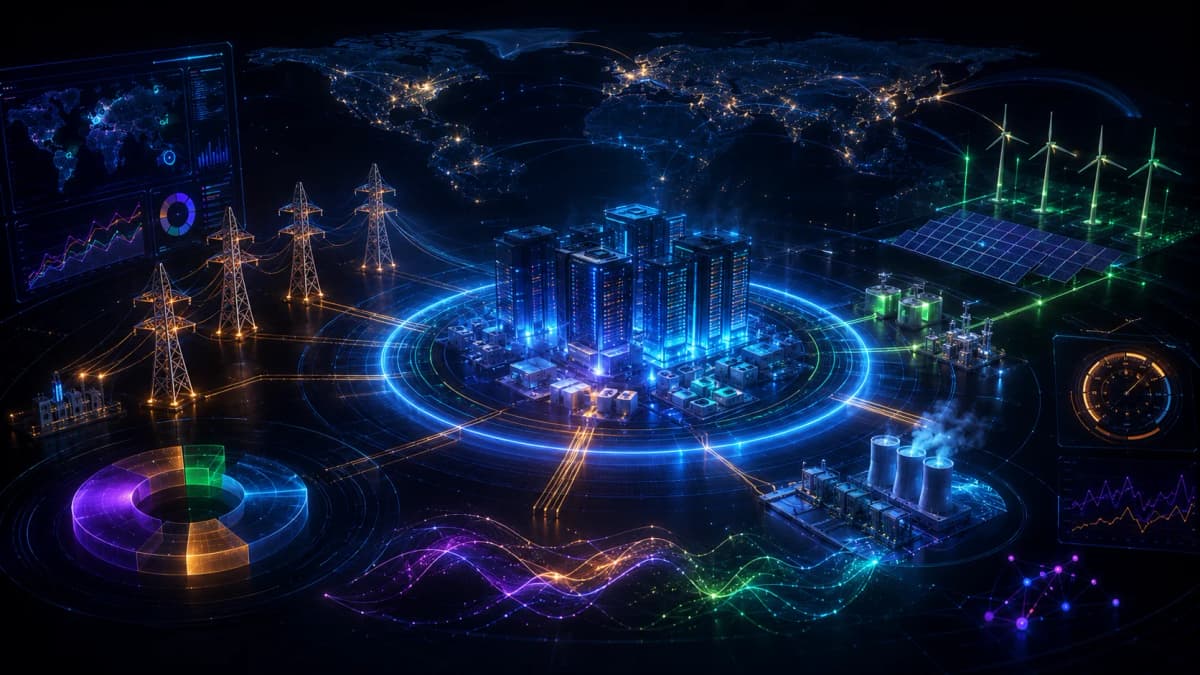
Goldman Sachs estimated that data centers use around 1-2% of global power today and could rise to 3-4% by 2030. It also estimated data-center power demand could grow 160% by 2030. The IMF summarized scenarios in which global data centers used about 500 TWh in 2023 and could reach around 1,500 TWh by 2030.
That is not "all electricity." It is also not nothing.
A useful scope check:
If data centers use 500 TWh now and 1,500 TWh later:

increase = 1,500 - 500 = 1,000 TWh
multiple = 1,500 / 500 = 3x
A 3x increase in a grid-connected industrial load can affect power prices, gas demand, transmission planning, water use, and emissions. The fear is valid when the claim is about infrastructure stress. It becomes hype when it implies civilization-scale energy collapse without doing the denominator math.
The Jobs Fear Is Also Real, But "Exposure" Is Not "Replacement"
The IMF estimates almost 40% of global employment is exposed to AI. In advanced economies, the estimate rises to about 60%. That sounds enormous, and it is.
But exposure has two directions:
- Complement: AI helps a worker do more, faster, or better.
- Substitute: AI performs tasks that reduce demand for some labor.
The IMF explicitly says roughly half of exposed jobs in advanced economies may benefit from AI integration, while the other half may face lower labor demand, lower wages, reduced hiring, or disappearance in extreme cases.
So the honest sentence is not "AI will take every job." It is: AI will change the task structure of a large share of work, and the gains will be uneven unless policy, education, and bargaining power catch up.
Hollywood Fear Is A Rights Fight, Not A Technology Phobia
Hollywood fear is easy to caricature as artists being scared of tools. That misses the core issue.
Creative workers are worried about consent, compensation, credit, voice cloning, digital replicas, style imitation, training data, and whether studios can use AI to weaken bargaining power. Those are legitimate concerns. A background actor whose body scan can be reused, a voice actor whose voice can be cloned, or a writer whose work trains replacement workflows is not imagining the risk.
But that does not prove every AI-assisted artwork is unethical. It proves that rights, disclosure, licensing, provenance, and labor agreements matter.
The distinction is important:
Valid concern: "Do not use my likeness, voice, or work without consent."
Overreach: "No ordinary person should create with AI tools."
The first protects people. The second protects scarcity.
Extinction Risk Should Be Taken Seriously Without Pretending It Is Measured
The Center for AI Safety statement says that mitigating extinction risk from AI should be a global priority alongside pandemics and nuclear war. Signatories include major AI researchers, executives, and public figures.
That matters. It means catastrophic risk is not just fringe internet panic.
But a statement of priority is not a measurement. It does not tell us whether the risk is 0.1%, 1%, 10%, or something else. It does not tell us the timeline. It does not prove that current systems are conscious, agentic in the human sense, or already beyond control.
The right conclusion is:
Catastrophic AI risk is serious enough for governance, evaluation, security, and international coordination. It is not precise enough to justify fatalism.
Public Concern Is A Signal, Not A Proof
Pew found that 52% of U.S. adults were more concerned than excited about AI in daily life in 2023, up from 38% in late 2022. Pew also found that 53% thought AI hurts more than helps people keep personal information private.
This tells us two things:
- Public concern is widespread and increasing.
- The concern is not evenly distributed across domains.
People can be worried about privacy while still seeing value in AI for health, search, productivity, accessibility, or education. That mixed feeling is rational. Most powerful technologies are not good or bad in one piece.
Productivity Evidence Cuts Against Pure Doom
A large NBER study by Brynjolfsson, Li, and Raymond examined 5,179 customer-support agents using a generative AI assistant. Access to the tool increased productivity by about 14% on average, with a 34% improvement for novice and lower-skilled workers.
That does not mean every AI deployment works. It means the claim "AI is only hype" is too simple. In some workflows, AI transfers patterns of expertise, improves throughput, and helps newer workers climb faster.
The danger is distribution. If productivity gains go mainly to capital owners while workers absorb disruption, society gets resentment instead of shared prosperity.
Digital Transformation: The Real Failure Mode
Many organizations will fail with AI for boring reasons:
- They buy tools before mapping workflows.
- They measure activity instead of outcomes.
- They ignore worker knowledge.
- They automate broken processes.
- They skip governance until something goes wrong.
- They treat AI as a replacement strategy instead of a capability strategy.
Digital transformation fails when leaders confuse installation with adoption. AI does not fix unclear goals, bad data, weak trust, brittle processes, or misaligned incentives.

The sound strategy is smaller and harder: choose one workflow, define the risk, define the metric, involve the people doing the work, test the AI against a baseline, and keep humans accountable where stakes are high.
Bottom Line
The truth is sharper than either side of the culture war.
AI fear is valid when it points to measurable harm: energy strain, labor pressure, privacy loss, synthetic deception, rights violations, and safety uncertainty. AI fear becomes hype when it collapses every concern into a single apocalypse story or uses real harms to argue against access, education, and creative agency.
The mature response is not panic. It is calibrated power: build better tools, publish clearer data, protect workers and creators, upgrade grids, disclose synthetic media where stakes are high, evaluate frontier systems, and teach the public how the technology actually works.
Truth does not need fearlessness. It needs proportion.
References
Citation Note: Some citations are open access (arXiv or DOI, where linked). Others are books or journal articles that may sit behind a publisher paywall. Use the linked DOI or arXiv when available. If you notice any citation errors, please let us know.